
Failing a teacher certification exam is one of the most discouraging moments in the whole process. You studied, you sat for it, and the screen told you no. If that's where you are right now, you're in larger company than you'd guess — the average first-time pass rate on these exams is around 45%, and plenty of people who are now teaching failed at least once on the way in.
Here's the part that matters: a failed Praxis isn't the end of anything. You can retake it; your teaching career isn't decided by one score, and the candidates who pass on a retake almost always do it the same way — by figuring out exactly where they lost points and studying only there. This page walks through what actually happens after a failed Praxis: the rules, the timeline, the cost, and the fastest path to passing the next time.
Bottom Line:
You can retake any Praxis test as many times as you need. You'll wait 28 days between attempts, and the single most useful thing you can do first is pull your score report and find your two or three lowest content categories.
Can you retake the Praxis if you fail?
Yes. There's no limit on how many times you can retake a Praxis test. You'll need to wait 28 calendar days between attempts on the same test, and you'll pay the exam fee again each time (ETS, verified June 2026 at ets.org). The 28-day wait applies even if you only need to retake one subtest, and even if you canceled your scores.
One piece of good news that's easy to miss: under ETS's Free After 3 policy, if your first attempt on a test was on or after October 1, 2025, you qualify for free retakes after three paid attempts on the same Praxis test title. You need a reported score from each of those three attempts (pass or fail counts), and once your third score is reported, ETS emails you a link to request a voucher. From there, it's unlimited free retakes for five years from that score-report date (ETS, verified June 2026 at praxis.ets.org). Two caveats worth knowing: it's available in most — not all — Praxis states, so check your state's requirements page, and it does not cover ParaPro or ParaPathways, which aren't Praxis test titles.
So the mechanics are rarely the real obstacle. You can almost always test again. The real question is what you do with the 28 days in between.
First, pull your score report
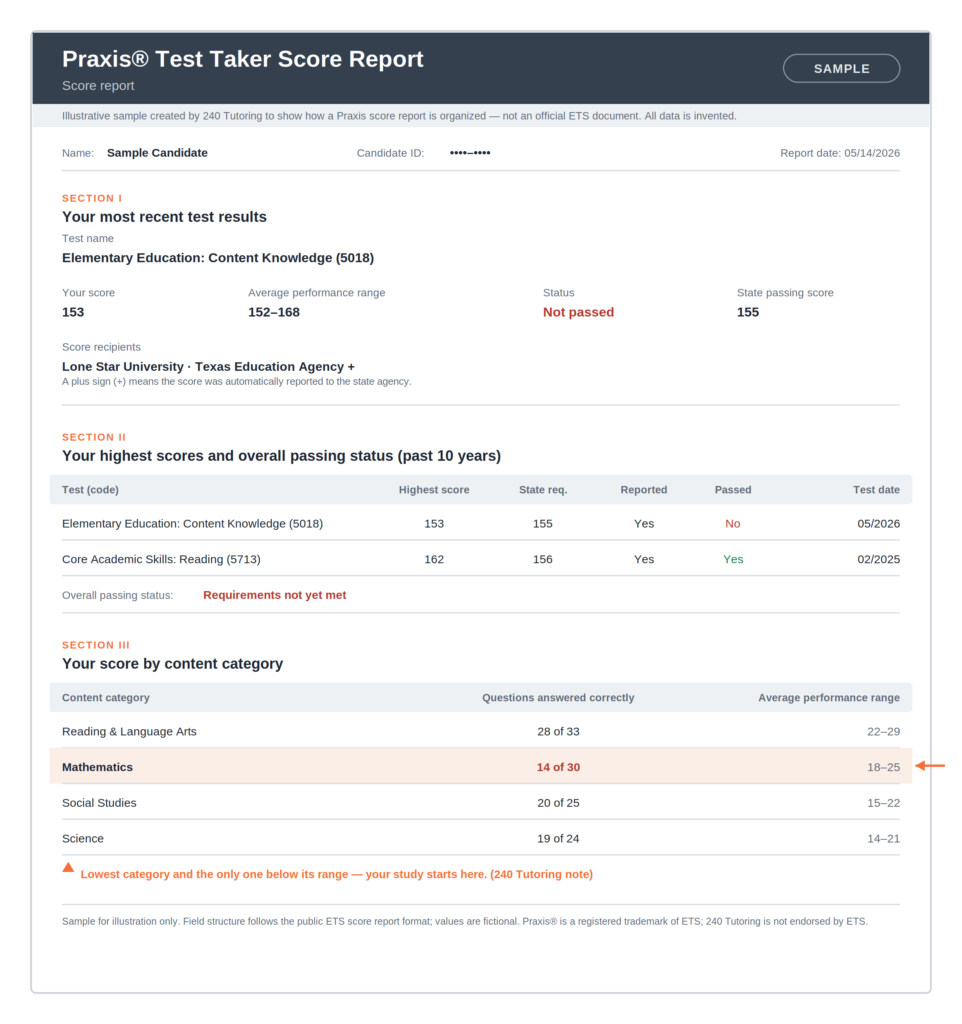
Before you book a retake or buy anything, read your score report closely. It's the most useful document you have right now, and most people glance at the pass/fail line and close it.
Your report shows three things worth your attention:
- Your scaled score (Praxis scores run 100–200) and whether it cleared your state's passing line. If you missed by just a few points, you're closer than it feels — see passing Praxis scores by state to confirm your exact target.
- A pass/not-pass status measured against your state's requirement, not a national one.
- Raw points by content category — this is the part that tells you what to do next. It shows where your points came from and, more importantly, where they didn't.
That category breakdown is your study plan. If you scored well on three categories and lower on one, you don't need to restudy the whole exam — you need to fix the one. (For a full walkthrough of how to read every line, see everything you need to know about Praxis scores.)
How close were you?
Two failed attempts can look identical on the surface and call for completely different plans. Use the gap between your score and your state's passing line:
- Missed by a few points. Your content knowledge is mostly there. Tighten your weakest one or two categories, do timed practice to fix pacing or careless errors, and retake as soon as your 28 days are up. Waiting longer rarely helps at this margin.
- Missed by a lot. This isn't a tune-up; it's a rebuild. Give yourself a few weeks to a couple of months, work through the content systematically, and don't book the retake until your practice scores are consistently clearing the line.
For exams with multiple subtests — like Elementary Education: Multiple Subjects (5001) — you usually only retake the subtests you didn't pass, not all of them. Check your specific exam's rules, because that can cut both your study load and your fees significantly.
How to study differently the second time
The mistake that produces a second failure is studying the same way again, just harder. If the first approach had worked, you'd have passed. Change the approach:
- Study to your score report, not to the whole exam. Put your time where your raw points were lowest. Strong categories don't need another pass.
- Practice under real conditions. A lot of retakes come down to timing and stamina, not knowledge. Full-length, timed practice tells you whether you can actually finish — and finish accurately — under pressure.
- Use a practice score as your green light. Don't rebook based on how prepared you feel. Rebook when your practice scores are landing above your passing line, repeatedly.
This is the part of the process where a structured study guide earns its place. The Praxis prep hub lays out how 240 Tutoring's system fits together: the Praxis guides start with a diagnostic that maps your weak areas and builds the plan around them, then give you full-length practice tests to confirm you're ready before you spend another exam fee. That diagnostic-plus-practice loop is the piece most directly aimed at the "I studied and still failed" problem.
A free Praxis practice test gives you a real starting point — and tells you exactly which content categories need the most work before your retake.
What it costs to retake
You'll pay the exam fee again on each attempt — there's no retake discount, aside from the Free After 3 vouchers covered above for eligible Praxis titles. Fees vary by test, generally running from around $50 for the ParaPro up to roughly $90–$209 for other Praxis tests depending on the exam and whether you bundle subtests (ETS, verified May 2026 at ets.org). For the full breakdown and the retake rules in one place, see your Praxis costs and retakes guide.
This is also where the math on study prep tends to land for most people: if one month of a study guide keeps you from paying for another failed attempt, it's already paid for itself. That's the honest case for it — not a guarantee that you'll never retake.
Real candidates who failed and then passed
These are anonymized from public reviews and pending verification before publish — but they're the pattern we see constantly: a failure, a change in approach, a pass.
A candidate had taken the PPR three times and failed all three, with their certificate of eligibility about to expire and a teaching job on the line. They switched to studying with the quizzes and flashcards — retaking quizzes until the answers clicked — and on the fourth attempt, in their words, "after my 4th time I passed it." — TrustPilot, approx. 2019
Another candidate had taken their middle-level math and English exams twice and failed both while studying from books. They tried a different format and "passed the next time I took my exam." — TrustPilot, approx. 2022
The throughline isn't the product — it's the change in method. Both of these people stopped doing what wasn't working and targeted their weak areas instead.
When 240 Tutoring might not be the fix
Honest part: a study guide isn't always the missing piece, and 240 isn't right for everyone in this situation.
- If you missed by one or two points and already know your weak category, you may just need a couple of focused weeks with free materials and timed practice. A subscription might be more than you need.
- If money is genuinely tight right now, the free full-length practice test is the cheapest way to see where you actually stand before you spend anything — including before you spend another exam fee.
- The format doesn't work for everyone. Some candidates find 240's practice questions tougher or differently weighted than their actual exam — one reviewer who got their refund put it bluntly: "the rigor is totally different than the test." Harder practice builds stamina for a lot of people, but if you learn best in another way, use what fits and supplement where you need to. — TrustPilot, approx. 2026
And one thing worth being upfront about: the 240 pass guarantee is real, but it's conditional. You have to score 90% or higher on one of the practice tests before your exam, take the exam within 30 days of your subscription ending, submit your score report, and request the refund within three months of the failed attempt. If you qualify, the refund covers up to two months of your subscription. It's a genuine safety net — just not an automatic one, so read the full guarantee terms before you count on it.
Frequently asked questions
28 calendar days between attempts on the same test, set by ETS. The wait applies even if you canceled your scores or only need to retake one subtest.
As many times as you need. There's no lifetime cap. If your first attempt was on or after October 1, 2025, you may also qualify for free retakes after three paid attempts on the same test under ETS's Free After 3 policy — offered in most Praxis states and for Praxis test titles only (not ParaPro).
Possibly. Under ETS's Free After 3 policy, if your first attempt was on or after October 1, 2025, you qualify for free retake vouchers after three paid attempts on the same Praxis test — unlimited retakes for five years from your third score report. ETS emails eligible candidates a request form after that third attempt. It's available in most Praxis states and applies to Praxis test titles only, not ParaPro or ParaPathways.
Yes, the exam fee applies to each attempt, unless you qualify for ETS's Free After 3 policy. Study costs are separate.
On multi-subtest exams like Elementary Education: Multiple Subjects, you generally retake only the subtests you didn't pass. Single-test exams are retaken in full. Check your specific exam's rules.
It's rarely worth the cost or the wait. Score changes from a review are extremely uncommon. If you missed by a point, you'll almost always pass faster by restudying your weakest category and testing again.
No. Schools care that you hold the certification, not how many attempts it took. Your retake clears the same bar as a first-time pass.
Study your score report, not the whole exam. Put your time in your lowest-scoring categories, practice under timed conditions to fix pacing, and use a passing practice-test score — not how prepared you feel — as the signal that you're ready to rebook.
Repeat failures usually trace back to one of a few fixable problems: studying broadly instead of targeting weak categories, never practicing under timed conditions, or a genuine content gap in one area. Diagnosing which one is yours is the first step — why so many candidates think they failed their certification test digs into this.
The next step
A failed Praxis feels like a verdict. It isn't — it's information. You now know more about this exam than you did going in, and your score report is pointing straight at what to fix. The candidates who pass on a retake aren't the ones who studied longest; they're the ones who studied where it counted.
If you want a clear read on where you stand right now, take the free full-length practice test for your exam. It's the fastest way to find your weak categories and decide what your next 28 days should look like — with nothing to commit to.