
Quick Answer: Praxis scores range from 100–200. Passing scores vary by state but typically fall between 130–160. Most unofficial scores are available immediately after your exam; official score reports arrive within 1–3 weeks.
Praxis scores range from 100 to 200. There's no single universal passing score. Each state sets its own cutoff, but most fall somewhere between 130 and 160. For many Praxis exams, you'll see your unofficial score the moment you finish the test. Your official score report typically arrives within one to three weeks. Whether you're trying to figure out what score you need, how scoring actually works, or what to do if you don't pass, this guide covers all of it.
Ready to learn more about Praxis scores? Let’s get started!
What Kinds of Questions Are on the Praxis and How Are the Praxis Tests Scored?
Praxis exams contain two types of questions: selected-response (multiple-choice) and constructed-response (written responses). Selected-response questions are machine-scored instantly, while constructed-response questions are reviewed by at least two human scorers. Your exam may include one of these types of questions or a mix of both. Praxis exams are scored between 100 and 200 points.
Selected-response test scoring
SR questions are scored automatically by a machine. Each correct answer is worth one raw point, and there is no penalty for incorrect answers, so making an educated guess is better than leaving a question blank.
The total raw score is the sum of your test’s correct answers. The scaled score is computed from the total raw-point number to adjust for question difficulty.
In exams with both selected-response and constructed-response questions, the raw score is the sum of the SR and CRQ ratings.
Constructed-response test scoring
CRQs are scored independently by at least two people with expertise in education and the content area.
In some subjects, the CRQ ratings are weighted depending on difficulty, and the raw score for SR and CRQ components may be scaled. Scaling ensures that test form differences do not affect the final score. Because test forms and subject assessments vary in the number of total questions, it is impossible to know how many questions you need to answer correctly to pass.
Pretest questions
Some tests may include pretest questions: one or more new questions being evaluated for possible use in future test editions.
Pretest questions are not identified to assess the test-taker’s responses under actual testing conditions.
Pretest questions do not count toward the score.
What's the Difference Between Unofficial and Official Praxis Scores?
The difference between unofficial and official Praxis scores is that your unofficial score appears at the testing center immediately after you finish, while your official score is released within 1 to 3 weeks. The unofficial score is calculated by taking the ratio of correct answers to questions, adjusted to the grading scale, and your official score is calculated the same way, but may be slightly adjusted to account for differences between test forms.
The official score may also differ from the unofficial score if a test center error or miscalculation is fixed, but this is rare. In most cases, the unofficial Praxis score you receive for math and reading exams at the end of the test should be very close to your official score.
Note that official Praxis scores are scaled only between different forms of the same test, not between other subjects.
How to view unofficial Praxis scores?
If your exam includes an unofficial score, you will be able to see the unofficial score report after you complete your exam. Usually the Praxis 1 (Praxis Core Academic Skills for Educators) exams have a unofficial score report at the end of the Reading and Math subtests.
When Will I Get My Praxis Scores?
For most selected-response Praxis exams, you'll see your unofficial score the moment you finish the test. Official score reports are released within one to three weeks, depending on your exam type.
For the Praxis Core exam, unofficial scores for SR-only tests Reading and Math are calculated immediately after the exam. You may also receive a raw score at this time. If you wish to cancel your scores, you must do so before viewing any unofficial or official score reports. (There are major potential impacts of canceling your scores, so consider this carefully.)
How Long Does It Take to Get Praxis Scores?
After a score is reported at the testing center, you will receive an official score report within three weeks. Score reports will appear automatically in your online account and be sent to your predetermined score recipients. Specific reporting dates for each test window can be found on the ETS website. Continuously given SR-only tests generally release official scores within one week. You can check when your score will be available based on your testing date here.
What are the Praxis Score Release Dates?
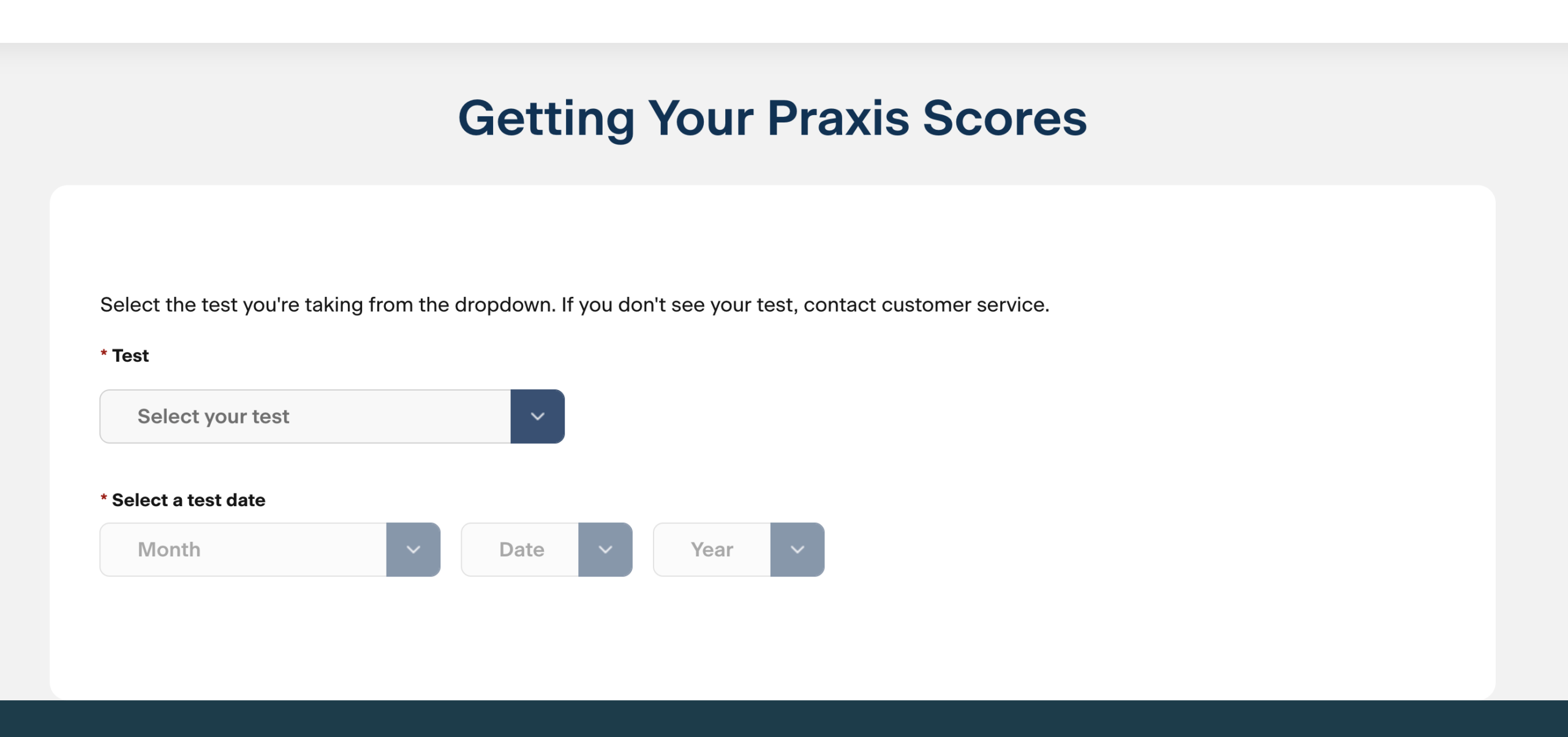
Your Praxis score release date will depend on the date you took your exam, so each exam has the potential to have a different score release date. You can use the ETS score report checker to determine when your score report will be available. You can check your official score in your Praxis account. Once the score report is available you will receive and email notification from ETS.
What Score Do You Need to Pass the Praxis Test?
ETS does not have a standard for Praxis passing scores, and different states/agencies vary in their passing requirements. A majority of the passing scores range from 130 to 160, depending on the state.
See the table below for a few examples of the varying passing scores for Praxis exams.
| Exam | Passing Score | Exceptions |
|---|---|---|
| Core Academic Skills For Educators: Reading (5713) | 156 | American Samoa: 142 Kentucky: 150 Maine:153 Nevada:150 |
| Core Academic Skills For Educators: Writing (5723) | 162 | American Samoa: 142 Kentucky: 158 Maine:156 Nevada: 156 North Dakota:160 South Carolina: 158 |
| Core Academic Skills For Educators: Mathematics (5733) | 150 | American Samoa: 134 Kentucky: 144 Maine: 147 Mississippi: 130 Nevada: 144 Pennsylvania:142 Vermont: 146 |
| Early Childhood (5025) | 156 | Missouri: 145 Virgin Islands: 152 |
| Elementary Education: Content Knowledge (5018) | 163 | American Samoa: 157 Wisconsin: 157 |
| Middle School English Language Arts (5047) | 164 | American Samoa: 161 Arkansas: 153 Indiana: 161 Kansas: 158 Kentucky: 159 Missouri: 153 Northern Mariana Islands: 158 |
| Algebra 1 (5162) | 157 | Mississippi: 148 Virginia: 148 |
We have a full article that breaks down all the passing Praxis scores by state!
How Do You Interpret a Praxis Score Report?
Your score report shows your scaled score, whether you passed or failed, your score range, and a breakdown of raw points by content category. If you didn't pass, the category breakdown is the most useful part because it tells you exactly where to focus before you retest.
Praxis score reports provide a numeric score and passing status, the score range, raw points from each category, the average performance range, and your high scores for previous tests. You can use the ratio of “raw points earned” to “raw points available” in different categories to evaluate your strengths and weaknesses for different content areas. If you don’t pass your exam, you could use that information to help you better prepare for the areas you are weak in.
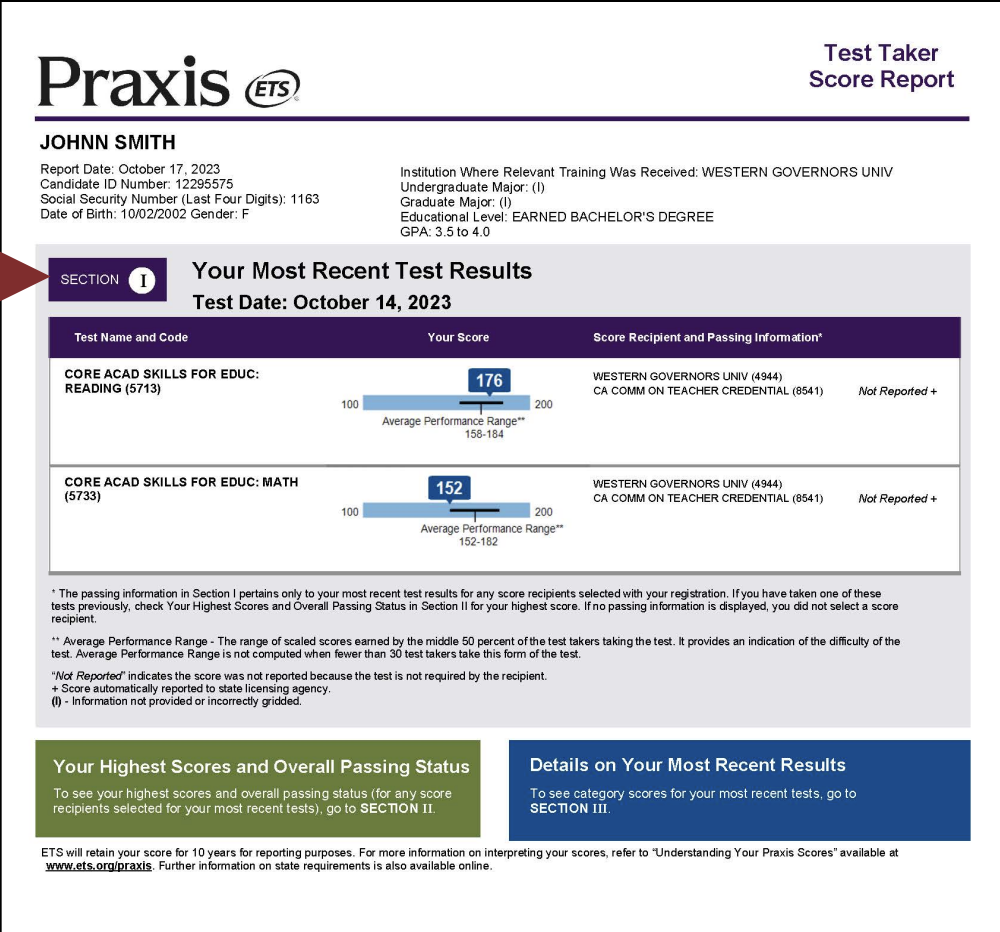
Your scaled score is compared to the qualifying score for your state agency, and PASSED or NOT PASSED is clearly indicated on the score report. Be aware that the official scores account for partial credit from questions with multiple correct answer choices. In contrast, the raw score gives each correctly answered question one point, regardless of the number of correct answer choices.
Examples of sample score reports are available on the ETS website.
How Long Do You Have To Wait Before You Can Retake a Praxis Exam?
You must wait 28 days before retaking any Praxis exam or subtest. There's no cap on the number of attempts, and ETS now offers free retakes after your third attempt on the same test.
If you fail the Praxis by just a few points, we recommend you double down on your weak areas and retake the exam as soon as you can.
If you fail by a lot, then we recommend you really buckle down and give yourself a few months of studying.
If you want to guarantee you'll pass your exam next time, subscribe to our Praxis Study Guide. We offer a money-back guarantee that you will pass. Plus, we offer a 48-hour, no-questions-asked refund policy if you just want to check it out.
How Hard Is It to Pass a Praxis Exam?
Praxis exams range in difficulty. They are not easy and require extensive preparation. Most states do not make their first-time Praxis pass rates available, and the pass rate data is only reported for people who complete the test.
Those who cancel their scores are not counted, according to a National Council on Teacher Quality report. Additionally, for people who take the same test multiple times, only their final score is counted.
The best preparation for Praxis exams involves making a study plan and sticking to it. An effective study plan should include learning about the test, collecting study materials, managing your time, and understanding scoring. We offer comprehensive, free resources and Praxis practice tests that will provide a free overview. Test information, engaging study guides, and practice questions are all conveniently located in one place to help you prepare for test day. If you want complete confidence you will pass your Praxis exam, get our Praxis study guide.
Pass Your Praxis Exam with Confidence Using Our Praxis Study Guides!
Frequently Asked Questions
Yes. ETS considers Praxis scores valid for 10 years, and your score report will indicate your highest score on any test within that window. When the 10-year mark passes, ETS removes your score report from your account and your scores are no longer considered valid by most licensing bodies. Some states may have stricter requirements, so always check with your state's credentialing office.
It depends on which test you're taking and which state you're in, but as a general benchmark: typical scores on most Praxis exams range from the 140s to the 180s. A "good" score is one that meets or exceeds your state's passing cutoff, which for most states falls between 130–160. If your score clears the qualifying threshold, you passed — that's what matters
Yes, in limited cases. If you feel your Praxis scores haven't been reported correctly or don't accurately reflect your performance, you may pay a fee to receive a score review for constructed-response questions. Selected-response scores are machine-scored and not eligible for hand-scoring review. Check the ETS website for current fees and the request process
During Praxis registration, you have the option to select up to four institutions or agencies that will automatically receive your test results when they are released at no charge. Any changes to score recipients must be made at least three days prior to testing. If you need to send scores after that, you can order additional score reports through your Praxis account. Each nonrefundable report costs $50 per score recipient.
Canceling your scores means they are permanently deleted — ETS will not release them to you or any institution. You cannot un-cancel scores once the decision is made. You'll need to retest and pay the full registration fee again. The 28-day waiting period before retaking still applies after a cancellation, so think carefully before going this route.
You may retake any section that you failed after a waiting period of 28 days. There's no limit on the total number of attempts. And there's a newer policy worth knowing about: ETS now offers free retakes for test takers who have completed three attempts on the same Praxis test, as long as your first attempt was on or after October 1, 2025. To qualify, you must have reported scores for each of those attempts and be within five years of the date your third attempt's scores were reported. This "Free After 3" program applies to all Praxis test titles.
Usually, yes — but not always. The unofficial score you see at the testing center is based on your raw correct answers adjusted to the grading scale. The official score goes through the same calculation but also accounts for any differences between test forms. In rare cases, a testing center error or miscalculation might cause a slight difference. For most test-takers, the two scores are effectively the same.
There are several editions of each Praxis test, and each edition contains different questions. The questions on one edition may be slightly more difficult or easier than those on another edition. To make all editions comparable, raw scores are converted to scaled scores that adjust for difficulty among editions. So a scaled score of 165 means the same thing regardless of which version of the test you sat for — that's the whole point of scaling