

See how prepared you are by taking our FTCE Chemistry 6-12 (003) practice test, and receive a personalized study plan after!
How Will the Practice Test Help Me Pass the FTCE Chemistry 6-12 (003)?
Taking a free 240 Tutoring practice test is the perfect first step toward passing your exam. It shows you how prepared you are and what you need to study first!
- Take your free 240 Tutoring practice test and receive a personalized study plan.
- Use this plan to begin studying and stay on track.
- Follow your plan, and you will be confident on test day!
 Step 1
Take a Practice Test
 Step 2
Study With 240
 Step 3
Repeat 1 and 2
 Step 4
Pass Your Exam!
FTCE Chemistry 6-12 (003) Practice Test Overview
Passing the FTCE Chemistry 6-12 (003) exam is a critical step toward your teaching certificate. We built this practice test to give you an idea of what to expect on the actual FTCE Chemistry 6-12 (003) exam and to serve as a diagnostic assessment to help you study.
Our practice test reflects the format and question types of the real exam. By taking it, you will better understand the exam's structure and content, and find the specific areas to improve before you take the official test.
The practice test has 50 questions covering 26 concepts.
The concepts covered include Mixtures and Solutions, Stoichiometry, Periodic Trends, Experimental Design, and much more!
We hope this practice test helps you gain the confidence you need to pass the FTCE Chemistry 6-12 (003) exam and move toward your career goals. Good luck!
FTCE Chemistry 6-12 Test Information
This examination determines if the test taker has the knowledge to be an entry-level science teacher in Florida’s school system.
Overview:
The FTCE chemistry exam covers eight competencies in chemistry, including topics in matter, chemical reactions, experimental theory, and the nature of science. About 40% of the test focuses on chemical reactions and molecular interactions.
Format:

The test is computer-based. Test-takers have two hours and 30 minutes to complete the test and need to score at least 200 (on a scaled score) to pass.
Scoring:
The FTCE chemistry exam is scaled to standardize individual scores across different test forms. The minimum passing score is 200, which represents about 72% of questions answered correctly. Unofficial pass/fail determination may be provided at the test center, and a detailed score report will arrive within four weeks.
Study time:
A study plan should include familiarizing yourself with the exam structure, including the exam competency topics. The PQ4R, or “Preview, Question, Read, Reflect, Recite, and Review” study method is recommended for this exam.
Tips that test takers wish they’d known:
- Try to arrive at the testing center 30 minutes before the appointment time.
- You should bring TWO forms of proper identification.
- Consider dressing in layers; testing rooms may be warm or chilly.
- Personal items, including cell phones, music players, wallets, watches, jewelry, food, and drinks, are not allowed in the testing room.
- Rescheduling and cancellation requests must be made online at least 24 hours before your scheduled exam time.
- There are no scheduled breaks. All unscheduled break time uses the available testing time.
- A periodic table including atomic number, chemical symbol, atomic mass, and relevant chemical constants will be provided by the testing center.
- A chemistry reference sheet, including melting/boiling point constants, standard heats of formation, vapor pressures, and standard reduction potentials, will be provided by the testing center.
- A scientific calculator will be provided by the testing center.
- Wrong answers are not penalized, so answer all questions.
Information and screenshots obtained from the FTCE and NES website.
Competency 1
This competency tests your knowledge of the nature of matter.
Let’s explore some specific topics within this competency.
Separating Mixtures
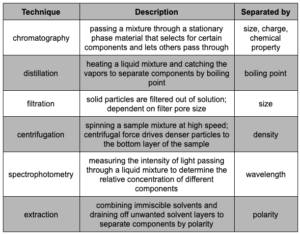
Separating mixtures is a commonly used technique across many fields of laboratory science. To name a few examples: oceanographers filter sediments from seawater, toxicologists extract chemical contaminants from environmental samples, medical technicians centrifuge tissue serums to separate cell types, and chemists distill pure compounds out of crude oil.
Key methods for separating mixtures are explained below.
Molecular Structure of Water
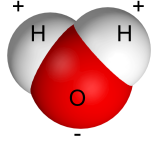
Water is a key component of life on Earth because of its unique physical and chemical properties. A water molecule (H₂O) is composed of one oxygen atom covalently bonded to two hydrogen atoms.
Polarity
Because oxygen is an electronegative atom, it has a strong affinity for electrons. In water, the oxygen atom pulls on the molecular electrons, which gives the O side a partial negative charge and gives the H side a partial positive charge. This means that water is a polar molecule. Nonpolar molecules, such as hydrocarbons and oils, have evenly spaced charges.
Water is sometimes called the “universal solvent” because it is able to dissolve a wide range of substances. Water can dissolve ionic and polar covalent substances such as salts and sugars. However, water cannot dissolve nonpolar substances, which is why oil and water form separate layers after being mixed together.
Hydrogen Bonding
The polar molecular structure of water initiates hydrogen bonding between adjacent water molecules. Hydrogen bonds are strong intermolecular forces between the partial positive charge of the hydrogen side and the partial negative charge on the oxygen side.
Physical properties of water related to hydrogen bonding include:
- surface tension
- adhesion
- cohesion
- high specific heat
- low solid density
Competency 2
This competency tests your knowledge of energy and its interaction with matter.
Let’s explore some specific topics within this competency.
Different Forms of Energy
The conservation of energy states that energy cannot be created or destroyed, but it can be transferred between different forms. Different forms of energy include:
- thermal – heat energy generated by a rise in temperature
- electrical – energy generated by the flow of ions, an electric current
- light – electromagnetic radiation generated by photons
- chemical – energy stored in molecular and atomic bonds
- nuclear – energy stored in atomic nuclei
- mechanical – energy from an object in motion
Examples of energy transfer:
- Plants convert light energy to chemical energy by making sugars via photosynthesis.
- Animals convert chemical energy to thermal energy by burning fuel from food to keep the body warm.
- Wind turbines convert mechanical energy to electrical energy by channeling the rotation of the blades into an electric current.
Endothermic vs. Exothermic
Chemical reactions generally involve a heat exchange between the reaction components and the environment.
Exothermic reactions release heat, increasing the temperature of the environment.
Endothermic reactions absorb heat, decreasing the temperature of the environment.
Whether a reaction is exothermic or endothermic depends on the chemical reaction and the identity of the reagents. In an exothermic reaction, the products are lower energy than the reactants, so the excess energy is released as heat. In an endothermic reaction, the products are higher energy than the reactants, so the extra energy is absorbed as heat.
Kinetic Molecular Theory
Kinetic molecular theory describes the behavior of particles (atoms, molecules, gases) with respect to heat energy in a closed container. It explains the relationships between volume, pressure, kinetic energy, and temperature for ideal gases.
The theory assumes the following:
- Particles are in constant random motion.
- Particles move in straight lines until they collide with another particle or the container wall.
- The volume of the particles is negligible relative to the volume of the container.
- Collisions are completely elastic; there are no attractive or repellent forces.
- Temperature measures the average kinetic energy of the particles.
Competency 3
This competency tests your knowledge of bonding and molecular structure.
Let’s explore some specific topics within this competency.
Types of Bonds
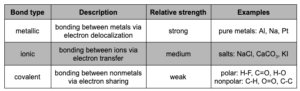
Bonds between atoms within a molecule are called intramolecular forces. The following table summarizes the different types of intramolecular chemical bonds.
Properties of Simple Organic Compounds
Organic compounds are chemical compounds that contain carbon and hydrogen. Organic compounds also commonly contain oxygen, nitrogen, phosphorus, and sulfur and form the basis for the chemistry of living things, or biochemistry.
Well-known organic compounds include:
- carbohydrate sugars, such as glucose (C₆H₁₂O₆)
- hydrocarbons, such as propane (C₃H₈)
- amines, such as tryptophan (C₁₁H₁₂N₂O₂)
- alcohols, such as ethanol (C₂H₅OH)
Lewis Dot Structure for Molecules
Lewis dot structures are a two-dimensional way to diagram chemical bonds and nonbonded electrons in a molecule using only the outer electrons, or valence electrons.
Lewis dot structures include:
- the chemical symbol of all atoms in the molecule
- lines to denote one pair of bonding electrons; double lines denote two pairs of bonding electrons
- dots to denote each nonbonded electron (e.g., a pair of dots represents a lone pair of electrons)
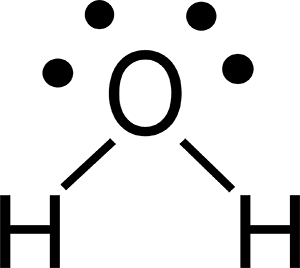
Interpreting the Lewis dot structure for water shows that a central oxygen atom is bonded to two hydrogen atoms with two remaining lone pairs. This structure satisfies the octet rule for oxygen because 2 lone pairs + 2 single bonds = 8 electrons for oxygen’s valence shell.
Naming Basic Chemicals
Chemical nomenclature is standardized internationally by IUPAC (International Union of Pure and Applied Chemistry).
To name chemical compounds, first evaluate the type of compound, then look at the individual atoms.
Ionic compounds
- If anion is polyatomic: Write the cation + polyatomic ion with the correct suffix. Examples: sodium chlorate (NaClO₃), calcium carbonate (CaCO₃), magnesium sulfite (MgSO₃)
- If anion is monoatomic: Write the cation + anion + “-ide” suffix. Examples: sodium chloride (NaCl), potassium iodide (KI), magnesium oxide (MgO)
- If the molecule is a covalent compound: Write the numerical prefix + “-ide” suffix. Examples: carbon tetrafluoride (CF₄), dinitrogen trioxide (N₂O₃), hydrogen sulfide (H₂S)
- Acids: If the acid is diatomic: Write “hydro-” + anion + “-ic acid” suffix. Examples: hydrochloric acid (HCl), hydroiodic acid (HI), hydrobromic acid (HBr)
- If the acid is polyatomic and the anion ends in “-ate”: Write the anion + “-ic acid” suffix (same as diatomic, but without the “hydro-”) Examples: chloric acid (HClO₃), iodic acid (HIO₃), bromic acid (HBrO₃)
- If the acid is polyatomic and the anion ends in “-ite”: Write the anion + “-ous acid” suffix. Examples: chlorous acid (HClO₂), iodous acid (HIO₂), sulfurous acid (H₂SO₃)
- Hydroxide bases: Write the cation + “hydroxide”. Examples: sodium hydroxide (NaOH), potassium hydroxide (KOH), calcium hydroxide (Ca(OH)₂)
Competency 4
This competency tests your knowledge of chemical reactions and stoichiometry.
Competency 5
This competency tests your knowledge of atomic theory and structure.
Let’s explore some specific topics within this competency.
Physical Properties of the Periodic Table
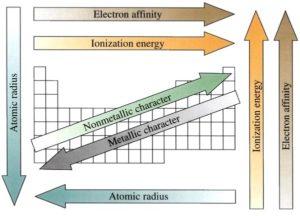
The periodic table has trends for different atomic properties. Key periodic trends are defined below.
- Ionization energy – the energy required to remove an electron from an atom. Ionization energy is the highest for small nonmetals because the electrons are closer to the nucleus and the attraction force is stronger.
- Electron affinity – the energy released when an electron is added to an atom. Electron affinity is highest for halogens and smaller atoms do not have full octet.
- Atomic radius – the distance from the center of the nucleus to the outermost electrons in an atom. Atomic radius increases with atomic number because more subatomic particles take up more space.
- Metallic character – how easily electrons are released from an atom. Metallic character increases with atomic number because larger atoms have a weaker attraction between the nucleus and the electrons
Nuclear Energy: Fission vs. Fusion
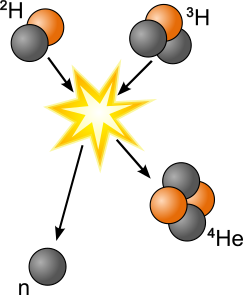
In nuclear fusion, small atomic nuclei are combined to create one larger nucleus. Generally, nuclear fusion reactions release neutrons; however, only lighter fusion products are exothermic. Heavy fusion products are endothermic. Solar energy comes from fusion reactions between hydrogen nuclei in the sun’s core.
In nuclear fission, large atomic nuclei are split into two or more fragmented nuclei. Generally, nuclear fission also releases extra neutrons, heat energy, and gamma radiation. Power from nuclear fission can be used to generate electricity.
Competency 6
This competency tests your knowledge of the nature of science.
Let’s explore some specific topics within this competency.
Scientific Inquiry
Scientific inquiry includes a series of steps that form the foundation for effective problem-solving across all fields of science.
The scientific method is summarized in the table below:
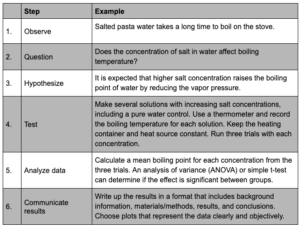
Scientific inquiry differs from nonscientific inquiry in that it aims to be systematic, unbiased, and quantitative. It is a form of active learning in which participants engage with each step of the scientific method. Non-scientific inquiry includes inductive reasoning and passive learning through lectures and readings. Inductive reasoning builds conclusions based on previous experiences, whereas learning from lectures relies on an authority figure to disseminate the information through a lecture or textbook.
Independent vs. Dependent Variables
Experiments use variables to test the effect of [A] on [B]. How does volume affect pressure for a gaseous mixture? Does hydrocarbon saturation affect the freezing point of a lipid? What is the effect of temperature on the solubility of sodium salts in water?
The independent variable is the parameter that causes an effect [A].
The dependent variable is the parameter being measured [B]. This is also called the response variable.
Competency 7
This competency tests your knowledge of measurement.
Let’s explore some specific topics within this competency.
Precision vs. Accuracy
Accuracy refers to how close a measurement is to the true value. Accuracy gives information about the correctness of the data.
Precision refers to how close a group of measurements are to each other. Precision gives information about the consistency of the data.
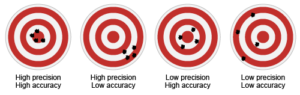
- Target 1 shows both high precision and high accuracy because all of the marks are clustered near the bullseye.
- Target 2 shows high precision and low accuracy because all the marks are clustered near each other but not near the bullseye.
- Target 3 shows low precision and high accuracy because the marks are not clustered together, but individually they are each close to the bullseye.
- Target 4 shows low precision and low accuracy because the marks are not clustered together and they are not close to the bullseye
Scientific Notation
Scientific notation is an abbreviated way to represent numbers that are very large and very small by using powers of 10. For example, 2000 is the same as 2 × 1000, which is the same as 2 × 10³. Scientific notation can use ‘E’ instead of ‘10’ (2 × 10³ is the same as 2E+3)
Example 1:
Write 0.000000000000045 in scientific notation.
Answer:
4.5 × 10⁻¹⁴. Each decimal position changes the scientific notation by a factor of 10. Since the decimal is moving to the right, add 10⁻¹ for each increment of 10.
Example 2:
Write 3920000000000000000000 in scientific notation.
3.92 × 10²¹. Each decimal position changes the scientific notation by a factor of 10. Since the decimal is moving to the left, add 10¹ for each increment of 10.
Competency 8
This competency tests your knowledge of appropriate laboratory use and procedures.
Let’s explore one topic from this competency.
Stay Safe in Labs
Safety is the key objective of any lab. Attention to safety is particularly important in chemistry, where hazards include toxic and corrosive chemicals, explosive reactions, broken glassware, and open flames.
General safety practices that should be reviewed regularly in a chemistry lab include:
- Always wear appropriate clothing, including long pants and closed-toe shoes.
- Always wear personal protective equipment (PPE), including goggles, lab coat, and gloves.
- Never eat, drink, or store food in the lab.
- Dispose of excess chemicals in the appropriately labeled waste container.
- Review the location and operation of safety equipment, including fire extinguishers, eye washes, and emergency showers.
- Open chemical containers away from faces, preferably under a fume hood.
- Never use glassware that is chipped, cracked, or broken. Dispose of in designated glass waste or sharps containers.
- Never taste or smell chemicals; instead, waft the air toward the face to sense odors.
- Always dilute acids by slowly adding concentrated acid to a container of water rather than adding water to a container of concentrated acid.
- Keep electrical outlets from getting wet or being overloaded
- Always notify a teacher immediately if there is a chemical spill or lab accident.
- Always wash hands with soap and water before leaving the lab or touching any personal items.
Other rules for standard chemical practice:
- Avoid cross-contamination by using clean utensils and never putting excess chemicals back in the original container.
- Read the volume of a graduated cylinder from the lowest level of the liquid line, or the meniscus.
- Use calibrated equipment (graduated cylinders, volumetric flasks, pipettes) for measuring and non-calibrated equipment (beakers, Erlenmeyer flasks) for mixing.
And that’s some basic information about the FTCE Chemistry 6-12 test.
Practice Test Format
You have unlimited time to complete all questions on the FTCE Chemistry 6-12 (003) practice test. You can't skip questions: each one needs a marked answer before you move on to the next.
Scoring
The FTCE Chemistry 6-12 (003) practice test is scored on a range of 0 to 100. More importantly, your score report shows your performance by concept.
Once you answer a question, you get immediate feedback on the correct answer, and when you complete the whole practice test you receive a full score report and a personalized study plan.
How to Use the FTCE Chemistry 6-12 (003) Practice Test
A practice test can be an effective tool for the FTCE Chemistry 6-12 (003) if you use it correctly! Follow these tips to get the most out of your free practice test:
- Mimic test-day conditions as best you can. Set aside enough time to take the full practice test, in a quiet area with minimal distractions, and without open notes.
- Use the practice test as a diagnostic tool to assess your strengths and weaknesses.
- Build a study plan from your score report, prioritizing the FTCE Chemistry 6-12 (003) concepts where you need the most improvement.
- Use 240 Tutoring! At the end of the practice test, we give you a personalized study plan based on your results to use right inside our study guides.